
Services - Other Services Overview ...
For your convenience, we have structured information on this page with On Page Links.
The headings are followed by an “On-Page Link” Button, which, when clicked, will navigate you directly to the selected section.
On-Page Menu Linking - Other Services Overview ...
Our Other Boardroom Services …
Our Other Expertise and Services …
Independence of our Services and your Tailored Solutions …
Our Other Boardroom Services ...
With our focus on the board and its role, we provide the following illustrative board-specific services that focus on strengthening boardroom leadership, ethical and effective practices, and therefore deliver sustainable value over the long term.
Please click on each of the “Toggle Indicators” or Overview Headings to display or close the relevant Sub-Sections:
Design and implementation of:
- the organisations’ Corporate Governance Frameworks and associated documentation.
- subsidiary Corporate Governance Frameworks and associated documentation.
Structuring of:
- the board, its functional and operational structures and terms of reference.
- the boards’ committees, their functional and operational structures and terms of reference.
- the organisation’s functional and operational structures and term of reference.
- the subsidiary company functional and operational structures and group terms of reference.
Definition of:
- chairman, director and company secretary roles and responsibilities and contractual terms of reference.
Tailored policies for:
- the organisations’ Corporate Governance Framework.
- the subsidiary Corporate Governance Framework.
- the board, its structures and its operations.
- the organisation, its structures and its operations.
- the subsidiary, its structures and its operations.
- support of the Delegation of Authority and Authority Matrix.
- Shareholders, Related Parties and other Stakeholders.
- development, approval and policy maintenance procedures.
Guidance to the board on and overviews covering:
- Corporate Governance for the board, current trends, changes and best practice.
- Strategy for the board, its role, responsibilities, strategy practices and working with the executive.
- Risk Management for the board, its role, responsibilities, framework and best practice.
- Risk Appetite for the board, its role, responsibilities and how to practically get this implemented.
- Board dynamics, skill sets assessment and skills rotations management.
We are well used to working with Boards to help them on specific mandates and programs that specially design and tailor presentations, facilitated sessions or fuller Board Programs to assist the Board in addressing its responsibilities and challenges.
We make it simple.
We are comfortable in one to one Director sessions, building consensus and trust around Board requirements, just as we are by introducing simple and easy to use modern facilitated electronic sessions, where your Directors simply have to “talk with their fingers and listen with their eyes“.
We bring all the gear and design your requirements into a well thought out, structured and simple process, to realise your goals.
Which ever approach, or their combination, makes good business sense for your organisation:
We Challenged the Status Quo and Achieve Simplicity to directly benefit you.
We think differently, to solve your challenges for long term benefit, in beautiful simplicity.
Simple to understand, Simple to implement and Simple to use.
We are Boardroom Leadership Governance, Risk and Compliance Experts.
Want to work with us?
- Governance framework and component audits and reviews.
- collective board reviews and self-assessment.
- individual board members review and self-assessment.
- individual board member peer assessment.
- individual board member governance liability assessment.
- board skill sets review.
- Chairman’s Agenda and Annual Planning review.
Director selection, appointment and rotation processes.
Definition of the requirements for and design of the board’s annual calendar.
Board meeting procedure and process development.
Board committee processes, reporting and information.
Board operational processes, covering aspects such as:
- Board strategy.
- Board decision making.
- Board risk assessment and risk appetite.
- Reserved and delegated powers.
Board and or shareholder statutory and other stakeholder meetings and related processes.
- effective and appropriate support to the board and its committees, their meetings and effective functioning.
- board papers, preparation, management, circulation and record keeping.
- legal, statutory, company, regulatory and governance compliance and communications.
- statutory, regulatory and organisational records.
- board member management, support and facilitation as a central point of contact.
- governance support, conflict of interest, whistle blower management.
- shareholder, stakeholder and public management and communications.
We have decades of Boardroom experience and in running electronic, anonymous, collaborative, real-time, facilitated or manual sessions, programs and or specific Board presentations to fit your Board Retreat program.
We are experts at helping Boards get to the key aspects of problems and challenges that they may be facing and wishing to address at these type of events, whether it maybe strategy through to building consensus around key matters.
Which ever approach, or their combination, makes good business sense for your organisation:
We Challenged the Status Quo and Achieve Simplicity to directly benefit you.
We think differently, to solve your challenges for long term benefit, in beautiful simplicity.
Simple to understand, Simple to implement and Simple to use.
We are Boardroom Leadership Governance, Risk and Compliance Experts.
Want to work with us?
Our Other Expertise and Services ...
Our expertise and scope of services brings together the critical components of boardroom leadership and organisational performance and governance requirements.
Our expertise addresses the nine key areas of the scope of services Governance framework illustrated below and detailed on the opposite slides.
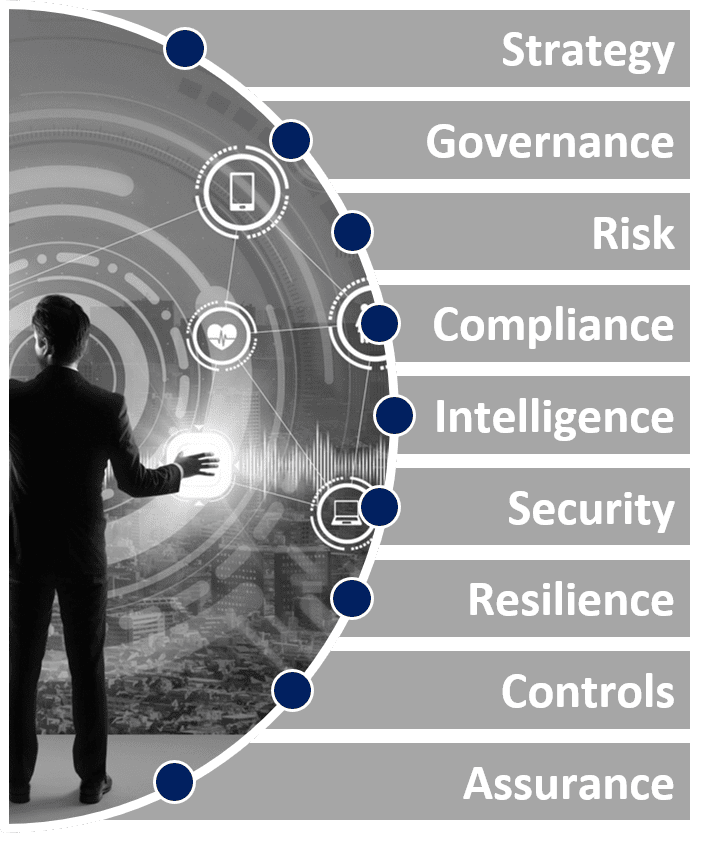
Please click on each of the “Toggle Indicators” or Overview Headings to display or close the relevant Sub-Sections:
We assist Boards and their organisational Leadership develop their Strategic Framework, and within this, their Strategy Development and Approval Processes, leading to execution, monitoring, reporting and ongoing strategy management activities.
We assist the Board in recommending and in implementing best practices for the Board to adopt in its Strategy Approach and its annual Strategy Agenda, in order to become a high performance Board.
This may involve the following broad strategy phases:
- Defining the overall Strategic Framework and initiating Key Processes
- Analysing and Defining the Options.
- Approving the Strategy.
- Executing the Strategy.
- Monitoring, Reporting and Adjusting on Strategy.
- Traditional Strategy Planning – those that are more suited to formally commencing their strategic journey from the start point of a defined strategic vision.
- Scenario Based Strategic Planning – those that are able to adopt and manage a scenario development process, to single out and assess the appropriate trends that are most likely to occur, identifying those most important to the success of the organisation, around which they actively plan and manage their course, cognizant of ongoing direction and their ability to adjust into or out of scenarios as they unfold.
Which ever approach, or their combination, makes good business sense for your organisation:
We Challenged the Status Quo and Achieve Simplicity to directly benefit you.
We think differently, to solve your challenges for long term benefit, in beautiful simplicity.
Simple to understand, Simple to implement and Simple to use.
We are Boardroom Leadership Governance, Risk and Compliance Experts.
Want to work with us?
We comment specifically on Governance focused at Board level in our Section below – “Our Specific Boardroom Services” that you may wish to read in conjunction with this section.
Governance broadly, is defined as the Structure and Process used to Direct and Manage the affairs of the organisation with the objective of enhancing stakeholder value. The structure and process define the Division of Power (Authority), Policies and establish the mechanisms for achieving Accountability amoung stakeholders, the governing body and management.
Corporate Governance applies to all forms of organisation that are incorporated to form legal entities separate from their founders, and is defined as the ethical and effective leadership by the governing body towards the achievement of the following governance outcomes:
- Ethical culture
- Good performance
- Effective control, and
- Legitimacy.
GRC Consulting believes in the achievement of the above four governance outcomes, that are of themselves embodied in sound corporate governance principles, which build on one another, reinforce each other and hold true across organisations, and are achieved through the application of best practices embodying each principle and its aspirations.
We assist Boards and their leadership in developing their:
- Structures – Both functional and operational, from the Board at holding company level, through subsidiary governance layers to group structures and their component parts and to ensure that these are consistent with the overarching strategy in order to maximise the organisations structural performance in pursuit of its strategic objectives.
- Processes – From those within and from the Board, into organisation wide operational processes, addressing their development, structuring, efficiency, effectiveness, improvement and overall management. We understand the critical nature of underlying processes to outcomes based organisations and their role within and in support of governance.
- Authority – defining authority at and within the Board and of its cascade throughout the organisation to ensure efficiency and effective leadership and decision making, with appropriate checks, balances, feedback and controls, to achieve organisation performance and strategic objectives.
- Policies – over their development, approval, implementation and maintenance, in order to give proper effect to strategy and strategic direction and the related frameworks, standards and plans that establish the scope within which judgement is exercised, decisions are made and actions taken in the ultimate stewardship of the organisation, its resources and direction.
- Accountability – appropriate structures and answering for the execution of all established material responsibilities, both at a Board and operational level, ensuring, whilst delegated responsibility is clear, defined, transparent, reportable and supported, that accountability is not delegated.
Which ever approach, or their combination, makes good business sense for your organisation:
We Challenged the Status Quo and Achieve Simplicity to directly benefit you.
We think differently, to solve your challenges for long term benefit, in beautiful simplicity.
Simple to understand, Simple to implement and Simple to use.
We are Boardroom Leadership Governance, Risk and Compliance Experts.
Want to work with us?
We believe that the organisation should be focused on and managing the business, not managing risks. Organisations do not prosper, add value and achieve their strategic objectives by managing risk. They do so by setting and then executing on strategies and objectives through making and acting on intelligent and properly informed decisions. Risk Management is therefore an integral part of all decision making across all levels of the organisation and consequently a central component of an organisation’s strategic management.
A key value we bring is helping Boards and organisations effectively and efficiently approach and address their risk governance frameworks, risk processes and help identify, evaluate and translate how risk matters may impact and affect the business, how to best manage these, therefore leading to appropriate mitigation controls and solutions, and leveraging opportunity, that ultimately assist in driving improved performance and enhanced achievement of strategic objectives.
The most simple definition of Risk, is “anything uncertain (positive or negative) that impacts on the achievement of objectives”.
Consider Risk Management, as the art of ensuring that you do not slip, by treading onto a “banana skin”! It operates to identify and pull it out of your path. Risk Management enables more informed decision-making, from the setting or modification of strategy to the decisions made constantly across the organisation. This is what executives do each and every day in pursuit of creating sustainable value.
“The effective management of risk enables more informed decision-making, from the setting or modification of the organisation’s strategy to the decisions made every day across the extended enterprise. The processes and related policies, structures and systems for identifying analysing, evaluating and responding to risks are established by management with oversight by the governing body to ensure that the effects of uncertainty (both positive and negative) on the achievement of objectives are understood and managed consistent with the desires of the governing body, for the purposes of achieving objectives, acting with integrity, and delivering optimal value to the organisations stakeholders.”
We help Boards and Leadership correctly approach and address their risk management frameworks and processes, for example:
- Establishment of the Risk Committee, its terms of reference, selection and training of Directors in their mandate and their terms of reference.
- Addressing how the Risk Committee establishes and implements its responsibilities for the governance of risk and how it should be approached and addressed in the organisation.
- Establishing policy that articulates and gives effect to the Boards’ direction on risk.
- Establishing and defining the Boards risk appetite and the ongoing processes by which it will be maintained and or updated as the organisation operates, including articulating the nature and extent or limit of the risks that the organisation should be willing to take, in pursuit of its strategic objectives.
- Articulating the definition of the Boards Risk Appetite into a cohesive framework for communication and cascade down through the organisations’ leadership and personnel.
- Assisting the executive leadership in its implementation of the risk management framework, processes, reporting, monitoring, management, decision making and periodic structuring of Board Information.
- Assisting on the integration and analysis of risk inputs to the overall organisation strategy and its ongoing direction.
- Conducting risk management facilitated workshops, together with detailed mitigation, solutions development and planning.
In our decades of undertaking risk management mandates over four continents, we have found that adopting electronic, anonymous, collaborative, real-time, facilitated sessions for our clients, to be the fastest, most efficient approach, that builds the highest team consensus and “on the same page” detailed understanding of cross organisational issues and what solutions are best required to address them.
We are experts at this approach, use of this technology and helping Boards and leadership get to the key aspects of problems and challenges that they may be facing, quickly, efficiently and in the most simple way.
Which ever approach, or their combination, makes good business sense for your organisation:
We Challenged the Status Quo and Achieve Simplicity to directly benefit you.
We think differently, to solve your challenges for long term benefit, in beautiful simplicity.
Simple to understand, Simple to implement and Simple to use.
We are Boardroom Leadership Governance, Risk and Compliance Experts.
Want to work with us?
We believe in and support the view that “compliance is an act of adhering to and the ability to demonstrate adherence to, mandated requirements, defined by laws, regulations, as well as voluntary requirements resulting from contractual obligations and internal policies” – the Open Compliance and Ethics Group (OCEG), and is a critical component of the organisations corporate defense framework, that we would also contend, extends to market conventions, industrial codes and best practices, and internal standards, policies, protocols and procedures.
There is a marked recent increase in the efforts by regulators and lawmakers to enhance and improve sound corporate practices, all of which devolve down to a corresponding marked increase in the threat of sanction to the organisation and prosecution and liability to individuals, particularly Boards and their Directors.
We believe that a proactive approach to compliance management and the development of an appropriate corporate compliance framework can provide and add significant value and strategic advantage. Simply, finding and fixing the problems (compliance) proactively is of greater value and effective use of organisation resources than not having appropriate compliance and its risks.
Given in practice that we see significant differences across jurisdictions and geographies, each organisation should ensure that it has appropriate compliance measures in place, particularly when its interests are geographically dispersed and its required development level positioned as a function of the maturity and complexity of the legal and regulatory frameworks within which it operates.
We help Boards and Leadership, recognising that there is often no unique perfect prescribed way to deliver a Compliance Program, and that its development maybe be suited to what works best for the organisation by ensuring that the fundamentals are properly developed and operating to support the achievement of strategic and operating objectives, such as:
- Oversight – Ensuring and or developing, that the Board clearly sets the direction for how compliance should be approached and addressed within the organisation and its oversight of the leadership and management and their reporting to the Board. This includes, where appropriate, a Board Committee and terms of reference, identified organisation personnel with clear terms of reference and authority, underpinned by a compliance vision, mission, strategy, plan, program of action and effective and efficient organisation wide compliance processes.
- Protocols – Ensuring and or developing, that the Board has established and approved appropriate policies and procedures to help ensure that the organisation is able to manage and achieve its compliance mandate and obligations. This should include defined and acceptable norms, including which non-binding rules, codes and standards have been adopted, and those norms that are equally unacceptable, together with the procedures and consequence for such, appropriately tied into the organisations integrity position, ethics policy, code of conduct and related best practices for daily business conduct.
- Due Diligence – Ensuring and or developing, from the Board down through management, in support of the governance principle of ethical and effective leadership, that the organisation has appropriate Board and personnel appointment and monitoring processes, controls and reporting.
- Education – Ensuring and or developing, that the organisation has established and maintains an appropriate education program to cement the desired culture, educate the Board and all personnel, communicating on a continual basis with regard to compliance obligations and their developments.
- Monitoring – Ensuring and or developing, that the organisation has appropriate and continuous monitoring and flow of compliance information into the correct level of decision making through back up to the Board, covering both the internal and external environment relevant to the organisation.
- Enforcement – Ensuring and or developing, that the Board and leadership have established appropriate continuous and consistent enforcement mechanisms, both those that work as incentives and those that are disciplinary, including whistleblower and other confidential lines of communication to independent, board and leadership layers.
- Response – Ensuring and or developing, that the organisation has put in place appropriate systems to respond to and manage compliance matters, including the rectification capability to learn from and adapt to incidents and changing environmental compliance and threat landscapes.
Which ever approach, or their combination, makes good business sense for your organisation:
We Challenged the Status Quo and Achieve Simplicity to directly benefit you.
We think differently, to solve your challenges for long term benefit, in beautiful simplicity.
Simple to understand, Simple to implement and Simple to use.
We are Boardroom Leadership Governance, Risk and Compliance Experts.
Want to work with us?
We believe that Intelligence and its management, in the most simple terms, is the organisational framework and processes, ensuring that it gets the right information to the right person, for the right purpose, in the right format, at the right time and place, in support of informed decision making and decision taking, from the Board right throughout the organisation. Organisational Intelligence is the capability of the organisation to create knowledge and use it strategically, operationally and to adapt in response to changing conditions. This is increasing critical in today’s “knowledge economies” and knowledge strategic competitive business environment.
We also contend, based on our practical board experience and knowledge of diverse industries and clients, that whilst some organisations are attuned to and better placed, much remains to be done for the broad remainder to truly harvest data and generate relevant, timely useful knowledge for strategic benefit, decision making and the creation of sustainable value.
We help Boards and Leadership develop these capabilities, at an appropriate depth and organisational coverage, to ensure that the organisation improves and enhances its critical decision making areas based on the best available intelligence and embed the necessary framework, policies, processes and procedures tied into the underlying data accessible to the organisation. This may include the develop of:
- Governance – balancing the current and future maturity needs of the organisation as to the Board and leadership level structures and personnel required to drive such frameworks, their terms of reference, mandates and authority and how they work within and with existing structures, so as to best enhance the organisations knowledge, strategic and decision making capabilities.
- Business Considerations – Ensuring and or developing, that the organisation appropriately considers, establishes and or leverages:
- Business Intelligence – How the organisation currently and how it should moving forward, address and best utilise: strategic intelligence; external and market intelligence; competitor intelligence; and operational intelligence.
- Knowledge Intelligence – How the organisation currently and how it should moving forward, address and best utilise: data, content, documents, records and their related processes to drive knowledge generation and management.
- Communication – How the organisation currently and how it should moving forward, address and best utilise: the formats of and needs for intelligence and the various channels of communication available to and best suit for conveying intelligence to the Board, leadership and across the organisation, including other stakeholders.
- Personnel and Skills – How the organisation currently and how it should moving forward, address and best utilise: its personnel at all levels, new skills and training and related intelligence requirements across the organisation, how these will be established, developed and provided.
- Data Considerations – Ensuring and or developing, the necessary controls and practices that will address the organisations data to ensure that it is appropriate: Accurate; Reliable; Relevant; Up to date; Objective; and Accessible.
- Intelligence Program Considerations – Ensuring and or developing, the appropriate environment and culture from the Board throughout the organisation to properly support the Intelligence framework, policies, processes, procedures and ultimately the generation of knowledge for decision support and its integration into the organisation, that is driven by a properly structured and authorised program that addresses: Organisation business requirements; Data; Information; Insight; Organisation actions; Knowledge, its management and uses; Organisational Learning and Strategic action.
Which ever approach, or their combination, makes good business sense for your organisation:
We Challenged the Status Quo and Achieve Simplicity to directly benefit you.
We think differently, to solve your challenges for long term benefit, in beautiful simplicity.
Simple to understand, Simple to implement and Simple to use.
We are Boardroom Leadership Governance, Risk and Compliance Experts.
Want to work with us?
We believe that security and security management, at its core, is simply the capability of the organisation to appropriately protect its critical assets, comprising, its people, information, technology and facilities from threat, thereby positively influencing stakeholder confidence and securing the organisations reputation.
Whilst fundamentally, this necessitates, basic and proper risk management, it also requires appropriate problem identification, management and elimination, in short, a security framework, policies, processes, procedures and reporting, amoungst others. Further, many organisation struggle with a disconnect between their Board and Leadership and Technology and Technology’s Leadership, particularly, understanding and communication of the technology business fundamentals, around which, in today’s increasingly technology centric organisations, technology is so critical and pervasive.
We help Boards and Leadership develop these capabilities, at an appropriate depth and organisational coverage, but focused at a governance level to the Board and Leadership, to ensure that the organisation develops, implements and embeds the necessary framework, policies, processes and procedures tied into the underlying organisation and its technology, data and systems, in order to adequately protect its critical assets. This may include the development of:
- Governance – balancing the current and future maturity needs of the organisation as to the Board and leadership level structures and personnel required to drive such frameworks, their terms of reference, mandates and authority and how they work within and with existing structures, so as to best protect the organisations’ critical resources.
- Security Program Considerations – Ensuring and or developing, that the organisation appropriately considers, establishes and or leverages:
- Safety – appropriate safeguards that protect the organisations critical resources from threat.
- Privacy – appropriate safeguards over the privacy of both data and its related parties. Particularly, given GDPR (Global Data Protection Regulations) and similar recent legislations.
- Confidentiality – appropriate safeguards that ensure access to information operates in accordance with its classification, such as sensitivity, importance and need to utilise.
- Integrity – appropriate safeguards that ensure that the organisations information can be trusted.
- Availability – appropriate safeguards that ensure that there is reliable authorised access to information.
- Business Considerations – Ensuring and or developing, that the organisation appropriately considers, establishes and or leverages:
- Assets Inventory – to inventory, classify and prioritise the organisations critical assets.
- Security Domains – to identify and consider the various domains within which the critical assets of the organisation reside with a view to their prioritisation and manner of safeguard.
- Threat Identification and Analysis – to identify and consider the possible types, sources and range of threat scenario’s, their response and action plans, in accordance with the standing of the various critical assets.
- Vulnerability – to identify and consider the organisations most possible and or likely aspects of vulnerability and extent, in relation to the threat landscape envisaged.
- Security Response Measures – to identify and develop, with appropriate classification, the range of related security response measures, their triggers, authorisation and execution processes and plans.
Which ever approach, or their combination, makes good business sense for your organisation:
We Challenged the Status Quo and Achieve Simplicity to directly benefit you.
We think differently, to solve your challenges for long term benefit, in beautiful simplicity.
Simple to understand, Simple to implement and Simple to use.
We are Boardroom Leadership Governance, Risk and Compliance Experts.
Want to work with us?
We believe that Resilience and its management is the capability of the organisation to sustain its business and operations and recover from material change and or disruptions.
We help Boards and Leadership develop these capabilities, at an appropriate depth and organisational coverage, but focused at a governance level on the Board and Leadership, to ensure that the organisation develops, implements and embeds the necessary framework, policies, processes and procedures, tied into the underlying organisation, to adequately protect its critical assets and sustain its business and operations. This may include the development of:
- Governance – balancing the current and future maturity needs of the organisation as to the Board and leadership level structures and personnel required to drive such frameworks, their terms of reference, mandates and authority and how they work within and with existing structures, so as to best protect the organisations’ critical resources and sustain its business and operations, particularly the integration and alignment of the necessary elements that give effect to a successful outcome against material change and or disruption.
- Resilience Program Considerations – Ensuring and or developing, that the organisation appropriately considers, establishes and or leverages:
- Preparedness – that the organisation is proactively prepared to deal with material change and or disruptions scenarios to its business and operations, with appropriate responses, rehearsals and practiced execution.
- Agility – that the organisation is proactively positioned to be agile in its approach, consideration and execution for material changes and or disruptions.
- Robustness – that the organisation is proactively robust through preparedness for material change and or disruptions, so as to effectively mitigate and or reduce the impacts to its business and operations.
- Redundancy – that the organisation is proactively redundant in critical areas such that it may have alternative options and considerations in the event of material change and or disruptions.
- Ingenuity – that the organisation is proactively prepared through the empowerment of its people to act with authority and ingenuity where required in order to creatively address possible material change and or disruption impacting the business or its operations.
- Speed – that the organisation is proactively prepared through the empowerment of its people to act with authority and speed where required in order to quickly address possible material change and or disruption.
- Adaptive Learning – that the organisation has embedded the necessary mechanisms to record, analyse and inject the learning points from its training and live responses to improve its capability.
- Business Considerations – Ensuring and or developing, that the organisation appropriately considers, establishes and or leverages:
- Resilience Engineering Capability – to develop and build the organisations ongoing ability to proactively identify and eliminate organisational points of weakness and building “cradle to grave” resilience in its critical assets.
- Incident Response – to develop and build the organisations ongoing ability and preparedness to dealing with and managing material change and or disruptions in a timely, effective and efficient manner.
- Emergency Operations – to develop and build the organisations ongoing ability and preparedness to dealing with and managing material change and or disruptions in an urgent and prioritised manner.
- Crisis Management – to develop and build the organisations ongoing ability and preparedness to swiftly dealing with and managing the emergence of crisis situations that have the potential to escalate into material adverse events.
- Continuity Management – to develop and build the organisations ongoing ability and preparedness to focus on and ensuring the organisations ability to sustain business and operations.
- Contingency Planning – to develop and build the organisations ongoing ability and preparedness to ensure the organisation has contingency options available to it under conditions of material change and or disruption.
- Disaster Recovery – to develop and build the organisations ongoing ability and preparedness to dealing with and managing the priority of the organisations critical resources and restoring them under conditions of material change and or disruption.
Which ever approach, or their combination, makes good business sense for your organisation:
We Challenged the Status Quo and Achieve Simplicity to directly benefit you.
We think differently, to solve your challenges for long term benefit, in beautiful simplicity.
Simple to understand, Simple to implement and Simple to use.
We are Boardroom Leadership Governance, Risk and Compliance Experts.
Want to work with us?,
We believe in and support the view that, “Internal Control is broadly defined as a process, effected by an organisation’s Board of Directors, management and other personnel, designed to provide reasonable assurance, regarding the achievement of objectives over: the effectiveness and efficiency of operations; reliability of financial reporting; and compliance with applicable laws and regulations – the Treadway Commission – The Committee of Sponsoring Organisations (COSO) – “Internal Control – Integrated Framework”.
We also believe in and support the position that the installation of an integrated framework of internal controls that is effective, is fundamental to safeguarding the organisations business, critical assets, resources and reputation.
We help Boards and Leadership develop these capabilities, at an appropriate depth and organisational coverage, but focused at a governance level to the Board and Leadership, to ensure that the organisation develops, implements and embeds the necessary framework, policies, processes and procedures, tied into the underlying organisation and its systems, in order to adequately protect its critical assets and reduce its risk exposures. This may include the development of:
- Governance and Oversight – ensuring and or developing, that the Board clearly sets the direction for how internal control should be approached and addressed within the organisation and its oversight of the leadership and management and their reporting to the Board. This includes, where appropriate, a Board Committee and terms of reference, identified organisation personnel with clear terms of reference and authority, underpinned by an internal control vision, mission, strategy, plan, program of action and effective and efficient organisation wide internal control framework.
- Internal Control Deliverables and Objectives – ensuring and or developing, an effective internal controls framework that helps the organisation mitigate risk and achieve strategic and related objectives, including:
- Financial Reporting Objectives – ensuring and or developing, appropriate financial controls that assist in ensuring the integrity, reliability, validity and accuracy of information systems, financial information and the reliability and ultimate presentation of the organisations financial and other reports.
- Operational Objectives – ensuring and or developing, appropriate operational controls that assist the organisation achieve its strategic and operational objectives, effective and efficient operations with appropriate use of the organisations resources and safeguard of its critical assets.
- Compliance Objectives – ensuring and or developing, appropriate compliance controls to ensure that the organisation complies with all relevant laws, regulations and internal and external codes, standards and best practices.
- Business Considerations – ensuring and or developing an appropriate balance within the internal controls framework, such that the internal controls not only address the organisations risk exposure but are cost effective in achieving this. Therefore, consideration of:
- Control Objectives – ensuring and or developing, appropriate consideration as to the objective of a control and the associated level of comfort that it may provide.
- Level of Risk – ensuring and or developing, appropriate consideration as to the associated and or anticipated level of risk, both inherent and post effective operation of the internal control and therefore determination / satisfaction of the remaining exposure.
- Level of Comfort – ensuring and or developing, appropriate consideration as to the establishment of the “reasonable” level of comfort required in various areas of the organisation and its operations.
- Control Types – ensuring and or developing the most appropriate range and application of preventative / detective vs manual / automated vs primary / secondary compensating controls.
- Control Locations – ensuring and or developing the most appropriate location for respective internal controls, in order to be effective and efficient.
- Internal Control Program Considerations – ensuring and or developing, an overall effective internal control framework and program that operates across the entire organisation successfully to provide reasonable assurance.
Which ever approach, or their combination, makes good business sense for your organisation:
We Challenged the Status Quo and Achieve Simplicity to directly benefit you.
We think differently, to solve your challenges for long term benefit, in beautiful simplicity.
Simple to understand, Simple to implement and Simple to use.
We are Boardroom Leadership Governance, Risk and Compliance Experts.
Want to work with us?
We believe in and support the view that assurance and assurance management, comprising both internal assurance and external (independent) assurance, may be defined as the frameworks in place that operate to provide an assessment to stakeholders as to the state of the organisation, its operation, financial reporting and other related matters, subject to understanding the scope of the two respective assurance components. The International Auditing and Assurance Board (IAASB) describes an assurance engagement as “an engagement in which a practitioner expresses a conclusion designed to enhance the degree of confidence of the intended users other than the responsible party.”
In simple terms, this is generally taken, when considering internal and external assurance, to refer to “Internal Audit/ors and “External Audit/ors” but not exclusively.
We help Boards and Leadership develop these capabilities around “Internal Assurance”, at an appropriate depth and organisational coverage, but focused at a governance level to the Board and Leadership, to ensure that the organisation develops, implements and embeds the necessary framework, policies, processes and procedures, tied into the underlying organisation, its systems and internal controls, in order to adequately protect its critical assets. This may include the development of:
- Governance and Oversight – ensuring and or developing, that the Board clearly sets the direction for how assurance, both internal and external assurance should be approached and addressed within the organisation and its oversight of the leadership and management and their reporting to the Board. This includes, where appropriate, a Board Committee and terms of reference, identified organisation personnel with clear terms of reference and authority, underpinned by an internal assurance vision, mission, strategy, plan, program of action and effective and efficient organisation wide assurance framework.
- Internal Assurance Deliverables and Objectives – ensuring and or developing, an effective internal assurance framework that helps the organisation mitigate risk and achieve strategic and related objectives, including:
- General Assurance – ensuring and or developing, the capability and business environment, such that, generally a range of assurance providers are able to provide adequate assurance that in general, the organisation is being managed and operated in an appropriate manner.
- Financial Assurance – ensuring and or developing, the capability and business environment that the financial information and reporting can be given adequate assurance as to the operation of financial controls and that the financial reporting is accurate, reliable and free of material misstatement. In practice this may only be possible for internal assurance on a narrower scope, subject to availability, skills and resources. On a broader basis, this is the province of external assurance.
- Non-financial Assurance – ensuring and or developing, the capability and business environment that the non-financial information, business activities and reporting can be given adequate assurance as to their operation in a satisfactory manner. This type of assurance, often more narrowly focussed, is generally the province of internal assurance.
- Specific Assurance – ensuring and or developing, the capability and business environment that specific issues are or have been addressed in an appropriate manner. Generally achieved through specifically focussed engagements.
- Business Considerations – ensuring and or developing, an appropriate framework, such that through a combination of internal and external assurance providers, that the Board is able to satisfy itself, other stakeholders and or the public at large, that its combined and applied assurance model, incorporates and optimises the various assurance services and functions, so that taken as a whole and as an integrated operating assurance framework, these support the objectives established for assurance over the organisation, its operations, critical assets and stakeholder requirements.
Which ever approach, or their combination, makes good business sense for your organisation:
We Challenged the Status Quo and Achieve Simplicity to directly benefit you.
We think differently, to solve your challenges for long term benefit, in beautiful simplicity.
Simple to understand, Simple to implement and Simple to use.
We are Boardroom Leadership Governance, Risk and Compliance Experts.
Want to work with us?
The Open Compliance and Ethics Group (OCEG) define Governance, Risk Management and Compliance (GRC) as:
“GRC is a capability, that enables organisations to reliably achieve objectives, while addressing uncertainty and acting with integrity”
Independence of our Services and your Tailored Solutions ...
As professional experts, the independence of our services ensures that we are accountable to our clients, their confidentiality and to ourselves exclusively.

GRC Consulting partners with each of its clients’ boards and organisations, so that we create and implement bespoke governance solutions for you.
We work with you, as unique and special, and focus on your individual needs.
Our tailor-made solutions are formed by direct and meaningful consultations with those relevant stakeholders to address critical boardroom, leadership and organisational performance and governance requirements.
Our professionalism and approach ensure discretion, whilst our independence ensures our accountability to our clients exclusively.
Our decades of practical boardroom, first-hand organisational leadership experience and years of professional services to some of the world’s top tier clients, combined with local regional cultural and understanding of the sensitivities, means that we have first hand experience in the complex realities of boardroom dynamics and the performance thresholds that boards and their organisation’s leadership must aspire to and the pressures that they face in these challenges.